
How to Build an AI Agent Consulting Practice That Generates Recurring Revenue

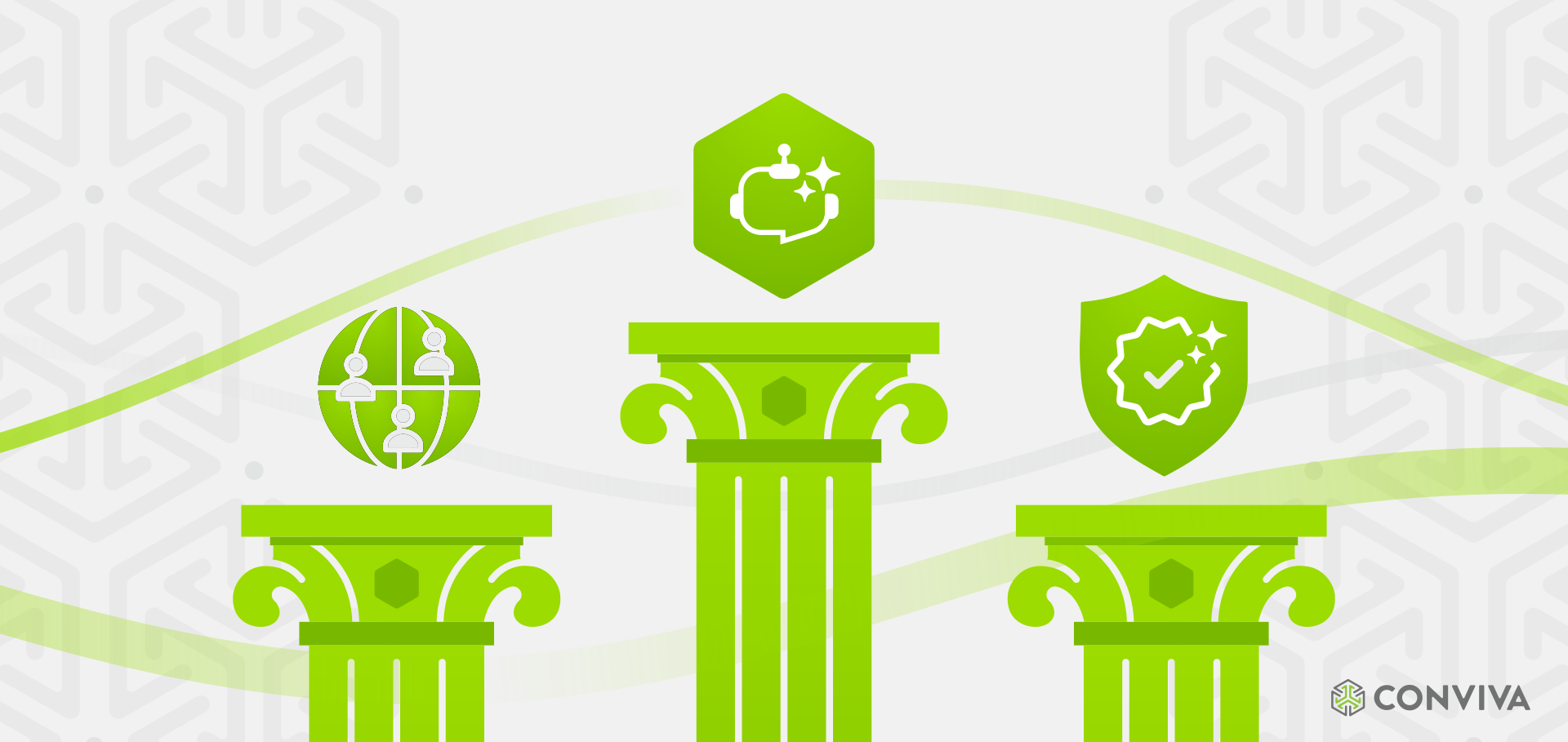
The short answer: consulting firms that win AI agent mandates will build their practice around three capabilities most competitors lack — behavioral design (building agents from real customer journey data), sequence-based training (training on how customers actually move across channels), and a continuous optimization retainer (a recurring engagement model tied to measurable agent performance). Firms that establish this model now will be years ahead of competitors still pitching generic AI readiness assessments.

Every major GSI has an AI strategy offering. Most of them say roughly the same things: assess readiness, identify use cases, build a roadmap, stand up pilots. The decks look different. The argument is the same.

Here’s what’s missing from all of them: the behavioral data to build consumer-facing agents that actually work.

Why You Can’t Build Consumer-Facing AI Agents without Behavioral Data

A big question I’m hearing from partners is “how do we build an AI agent practice?” What they should be asking is “how do we build agents that outperform everything else in the market?” Any firm can do implementation. The ones that win the next five years will be the ones who can walk into a client and say something nobody else in the room can say.

Right now, most AI agent work follows the same pattern digital transformation work always has: assumptions backed by best practices, validated by case studies, measured against benchmarks the client didn’t set. Agents get built based on what stakeholders think customers want, trained on whatever data is available, and launched with limited ability to course-correct when real behavior doesn’t match the hypothesis.

The result is consumer-facing agents that underperform. Not because the technology is wrong. Because the strategy wasn’t grounded in what customers actually do.

A Three-Stage Framework for Positioning AI Agent Consulting Services

The consulting firms that will dominate AI agent work over the next five years won’t win on implementation speed, partner credentials, or price. They’ll win because they can build consumer-facing agents from real behavioral data — and continuously improve them as that behavior changes.

That requires something most firms don’t have: a continuous behavioral signal from the client’s actual digital experience. Here’s how to build a practice around it.

Stage 1: Map Customer Behavioral Patterns Before Building the Agent

Before an agent goes live, map every significant behavioral pattern across the client’s apps, websites, and existing digital touchpoints. Which journeys are most common? Where do customers abandon? Which workflows generate revenue and which generate friction? This behavioral map becomes the foundation for the agent

Stage 2: Train the Agent on Real Behaviors, Not Sample Queries

Most consumer-facing AI agents are trained on intent categories and sample queries. The more defensible approach is training on behavioral sequences — the actual paths customers take across channels, ranked by business impact. An agent trained on behavioral sequence data routes more accurately, escalates less often, and reaches resolution faster from day one. You’re not guessing at what the agent should prioritize. The data tells you before a single session is live.

Stage 3: Run a Continuous Optimization Retainer Tied to Business Outcomes

This is where the recurring revenue model lives — and where most firms leave significant money on the table. Consumer behavior doesn’t stay static. New products launch. Friction points shift. Journeys that worked in Q1 break in Q3. A continuous behavioral signal means new patterns surface every sprint cycle, and each pattern is a reason to update the agent, improve routing logic, and expand what it handles. The retainer doesn’t end because the client’s product never stops changing.

Why AI Agent Consulting Creates a Net-New Recurring Revenue Model

Traditional consulting engagements have a finish line. Implementation ends. The team rolls off. The client either renews or doesn’t, and you’re back to finding the next problem.

AI agent consulting — built on a continuous behavioral signal — doesn’t have a finish line. The data creates a feedback loop: the agent improves, new behavioral patterns emerge, new service opportunities surface. The engagement evolves rather than concludes.

That’s a structurally different revenue model. Instead of competing for the next statement of work, you’re embedded in the client’s product cycle — continuously improving the AI system they rely on most to serve their customers.

The GSIs that establish this model first will be years ahead of firms still debating how to structure their first AI strategy deck. This isn’t a methodology you can replicate from a competitor’s case study. The behavioral data is proprietary to each client. The practice built around it is specific to your team.

What Behavioral Data Infrastructure an AI Agent Consulting Practice Requires

The reason most firms can’t build this practice today isn’t talent or methodology. It’s data. Without full-sensus stateful data from the client’s live digital experience, you’re building and optimizing agents against benchmarks that don’t reflect how this client’s customers actually behave.

The infrastructure requirement is simpler than most firms expect. Conviva deploys via a single SDK through tag manager in under two hours — no instrumentation, no engineering sprint, no schema design. Within 30 days, your team has a complete view of the behavioral patterns that exist across every app, website, and digital touchpoint. These patterns are the foundation of the agent design in Stage 1. They create the blueprint for training priorities in Stage 2, and are continuously updated to create optimization targets throughout the retainer.

The timeline that makes this practice viable at scale: deployment in hours, initial signal validated within two weeks, behavioral patterns delivered within 30 days, new drivers surfacing every sprint cycle as the client’s product evolves.

Each sprint cycle surfaces new patterns. Each new set of patterns is a reason to improve the agent. Each improvement is billable. Each billing cycle extends the relationship.

The agent practice never runs out of work because the behavioral data never stops generating it.


If you’re building out your AI agent offering and want to see what a behavioral-data-driven practice looks like for a specific client you’re already working on, I’d like to show you.

Ready to chat?  Book 30 Minutes With Me

Want to learn more first? Read: How to Win Outcome-Based AI Consulting Deals Before the Engagement Starts.


Sean Wilkinson leads Strategic Partnerships at Conviva. He works with GSIs, consultancies, and technology partners to build outcome-based services practices powered by Conviva’s digital intelligence platform.