How to Prove Consulting Outcomes to Clients Before the Engagement Starts

I spend a lot of time talking to practice leaders at the world’s largest services firms. Right now, there’s a version of the same conversation happening everywhere.

Clients are no longer satisfied with strategy decks and implementation timelines. They want to know — before they sign anything — what the outcome will be. Not a projection. Not a hypothesis on the last slide. Proof.

Accenture’s Chair and CEO Julie Sweet said it on the company’s Q1 2026 earnings call: “Clients cannot simply experiment. They can’t take a flyer. They have to know that when they’re investing with a partner, they’re going to deliver results. We are starting to see more focus on trying to get to outcome-based.”

She’s right. And the GSIs that figure out how to respond to that pressure first are going to win a disproportionate share of the market. The ones that don’t will keep fighting over the same commoditized deals at shrinking margins.

Here’s the hard truth: you don’t have the tools to prove outcomes — at least, not yet.

Why Consulting Firms Are Losing Outcome-Based Deals

The pressure on GSIs is coming from two directions.

The first: clients believe AI means they need less of you. They’re shrinking scope, shortening timelines, and asking whether a six-month engagement can be done in six weeks.

The second: clients believe AI means you should be doing far more with far less. If your firm is using AI effectively, they reason, the same senior talent should be delivering three times the output at a fraction of the cost. They’re not entirely wrong — which is what makes it so uncomfortable.

Both pressures converge on the same knife’s edge: prove the value, or get cut. And the forgiveness window has collapsed. It’s not a two-year contract with a twelve-month runway to show results anymore. It’s a rolling monthly commitment. Miss the mark on ROI and the engagement is over before your team has a chance to course-correct.

Every major GSI is running into the same structural problems underneath all of this. They’re not execution problems. They’re intelligence problems — and AI is making them harder to hide.

  • You’re scoping on assumptions. Without knowing what actually drives outcomes for a specific client, proposals are built on benchmarks and hypotheses. Clients can sense it. The firms walking in with quantified opportunities from the client’s own behavioral data are winning deals they shouldn’t otherwise win.
  • Projects end. Retainers don’t renew. Without a continuous source of new, quantified opportunities emerging from the client’s live digital experience, the retainer conversation dies. Most firms are relying on intuition and relationship capital to find the next problem, and that’s not enough anymore.
  • Clients can’t see the ROI until it’s too late. Seventy percent of digital transformation projects fail. Clients have been burned and they have long memories. They want to see value in their own data before they commit. A well-reasoned argument doesn’t move procurement. Evidence does.
  • Every GSI is pitching the same playbook. Strategy, implementation, optimization. Your competitors say the same words. The firm that walks in with a revenue-ranked map of behavioral drivers built from the client’s own data wins because nobody else in the room can show them that.

How to Walk Into a Client Meeting With Revenue-Ranked Proof, Not Projections

What if your teams could walk into a client meeting — before the engagement even starts — with a revenue-ranked map of behavioral drivers built from that client’s actual data? Not a framework. Not a comparable. Their data. Their users. Their money being left on the table.

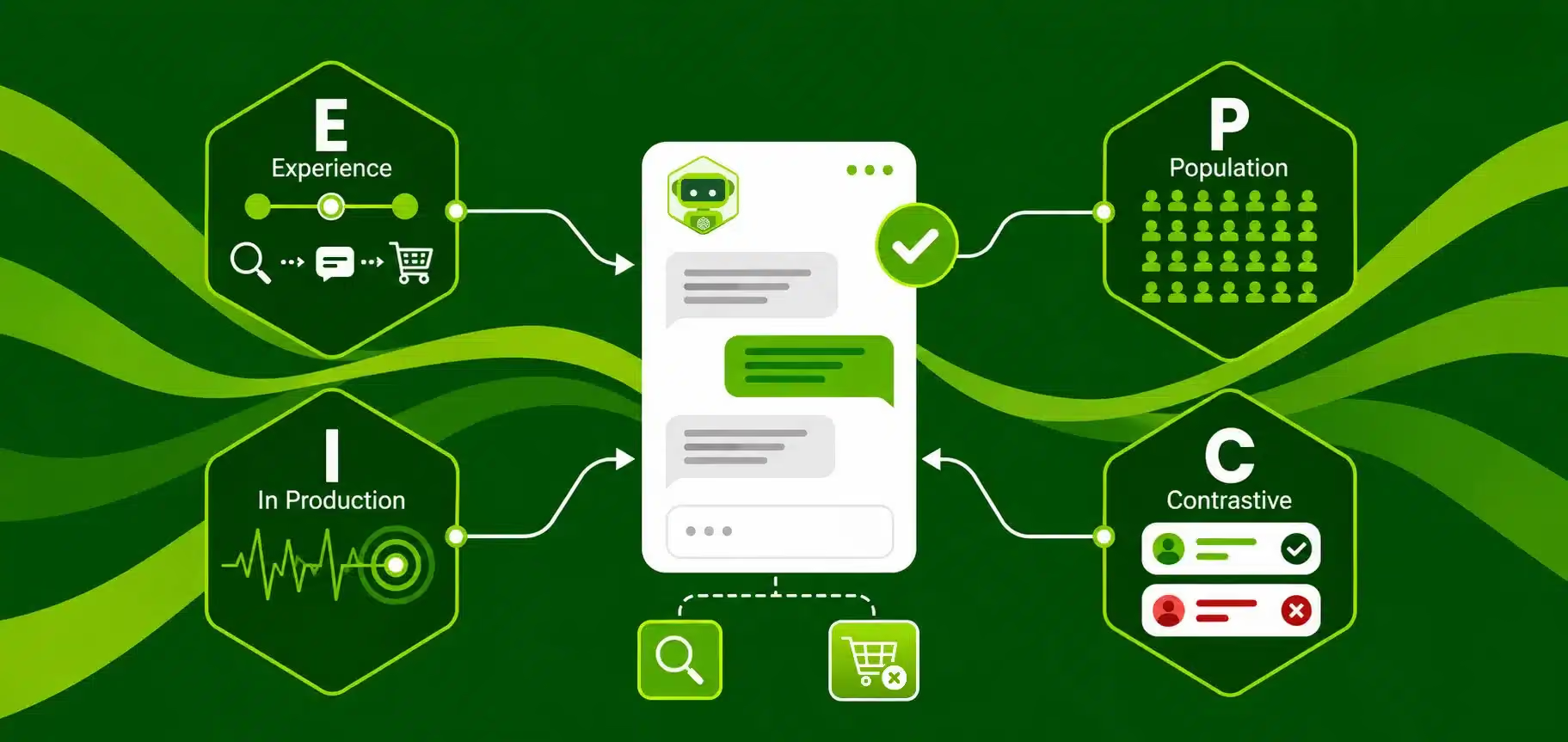
That’s what Conviva enables. One SDK deployed via tag manager in under two hours — no instrumentation, no engineering sprint, no schema design. Within 30 days, your team has a map that shows every significant pattern across the client’s apps, websites, and AI agents, ranked by estimated annual revenue impact, with each driver scoped to a services engagement your team can take to market.

The value assessments we’ve built for clients in retail, travel, and hospitality routinely surface $40–60M in Year 1 opportunity — across UX remediation, auth flow rebuilds, personalization strategy, agent optimization, and more. Each one is a conversation. Each one is a statement of work.

The firms we’re working with lead with Conviva’s behavioral driver assessment as their door-opener — walking into prospects with quantified opportunities from the client’s own data rather than a generic pitch. It creates a reason to have the value conversation before the scope conversation, and it changes the dynamics of the entire sales cycle.

From there, the partnership can take different shapes — co-selling with Conviva and your practice team in a joint pursuit, or embedding the analytics capability inside your existing offering entirely under your own brand. The engine is ours. The engagement is yours.

Deployment in hours. Signal validated within two weeks. Behavioral driver map delivered in 30 days. New drivers emerging every sprint cycle as the client’s product evolves.

The diagnosis is done. You bring the fix.


If you’re leading a digital practice and the outcome-based question keeps coming up in your client conversations — and it will — I’d like to show you what this looks like for a specific client you’re working on right now.

Book 30 Minutes With Me


Sean Wilkinson leads Strategic Partnerships at Conviva. He works with GSIs, consultancies, and technology partners to build outcome-based services practices powered by Conviva’s digital intelligence platform.