The world record high jump is just over eight feet, set by Cuba’s Javier Sotomayor more than thirty years ago. Now imagine someone showing up to a track meet and clearing sixteen feet. Not inches higher, not marginally better, but a doubling of what humanity thought was possible.
That’s what the AI era feels like.
I’ve spent my career with a front-row seat to many of the shifts that have defined technology over the past several decades. It began with the commercialization of the Internet and progressed through the birth of cloud computing, to modern app development, observability, and now Agentic AI. This one is fundamentally different. It redefines what people and teams are capable of, and how work gets done.
For the past decade, my teams at Salesforce, Splunk, Dynatrace, and Conviva have marketed commercial AI offerings. Our role, in summary, was to help explain the value of AI. Now, we are using it. What we’re experiencing is not incremental improvement. It redefines what teams can do.
People across marketing, sales, engineering, and beyond are building. In many cases, teams outside of marketing are producing assets that rival or exceed what marketing alone would have created. At the start of this year, I saw a path to 3x productivity gains. Now I see 10x.
Just a few Fridays ago, I asked my team to reflect on their biggest “aha” moments from the week.
The response was simple: “Wow. Mind blown again.”
In less than a month, these moments have started to happen daily. Projects that once took weeks – first-call decks, explainer videos, tailored demos, and even full websites – are now achievable in hours.
The biggest shift is mental. I went from thinking, “AI is not ready for that,” to something very different. AI is ready. I just need to approach the problem differently.
Becoming Superhuman
To thrive in this era, teams need to operate with AI as a central part of how they think and work, not as a downstream tool. Start with AI, stay with AI, and resist the pull back to manual workflows.
In many organizations, marketing will become the function that defines how AI is applied across the business. Marketers shift from creating assets to building systems and workflows that scale.
This shift favors broader skill sets. Generalists are more valuable than specialists. At the same time, everyone must understand and own the outcomes they drive. Impact across the sales cycle is now a shared responsibility.
AI is also changing who contributes to marketing. Sales, product, and anyone with access to these tools can now create high-quality assets. As responsibilities converge, alignment across teams and consistency in how the brand is expressed becomes critical. A practical approach is encoding brand and messaging guidelines into reusable systems, like a Claude Skill, so every content creator operates from the same standards.
Finally, elements of our human approach become more important, not less.
Trust. Integrity. The handshake.
These will matter even more in a world where so much can be automated. The ability to recognize what’s good, filter out low-quality AI output or “slop,” and apply judgement is now a core skill.
Learning in Real Time
We are actively exploring what AI-first, and increasingly, AI-only, workflows look like. That means constant experimentation.
Gemini, ChatGPT, and Claude each have strengths. We choose tools based on the task, for example, writing, creative and design, or deep investigation. Another observation: the strengths of each AI model evolve rapidly, sometimes weekly. To keep up, our team discusses and debates our experiences with different LLMs openly, shares what works, and evolves quickly.
The shift, however, is less about tools and more about how work gets done. My team is already creating customer-ready assets in minutes instead of weeks. Writing has improved faster than visuals, but that gap is closing quickly. Soon, generating world-class presentations, demos, and videos from a few prompts will feel normal.
For my team, evolution hasn’t been perfectly smooth. The learning curve is real and exploration can slow production. Yet, that is the price of relevance.
A Small and Mighty Team
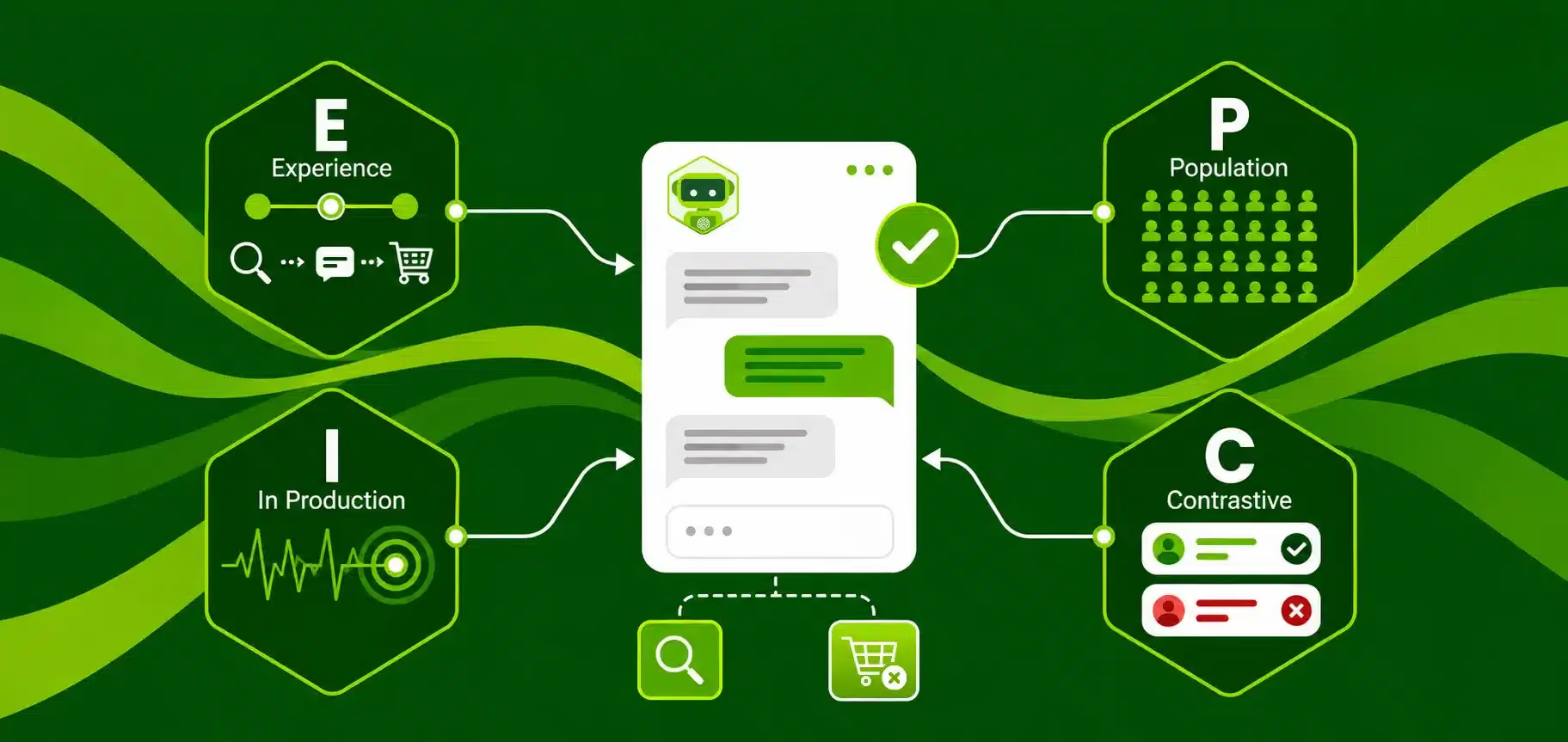
At Conviva, this transformation aligns with our company’s mission. We help companies succeed in a world of AI agents by enabling them to see and understand the outcome of every consumer interaction and conversation. We analyze experience patterns, surfacing what drives success and efficiency, and those that create friction and confusion. As more consumer interactions become AI-mediated, understanding these patterns becomes the foundation for growth.
We are helping our customers embrace the AI era with confidence. Change is driven by a visionary CEO and CRO, AI-curious leaders across sales, product, and engineering, and a team of four marketers.
We are learning in real time, pushing each other and embracing the discomfort that comes with learning something new. At the same time, the broader culture is evolving. The walls between product, marketing, and engineering are coming down. Teams are building, solving problems, and accelerating together.
The Choice
This is not a distant transformation. It’s happening now, faster than any shift before. We are diving in, proving every week that what felt impossible yesterday is now possible.
AI hasn’t just raised the bar, it has reset it at a level that once seemed impossible. The question is not whether it will change how you work. The question is whether you are preparing to clear it.