




What agentic analytics means
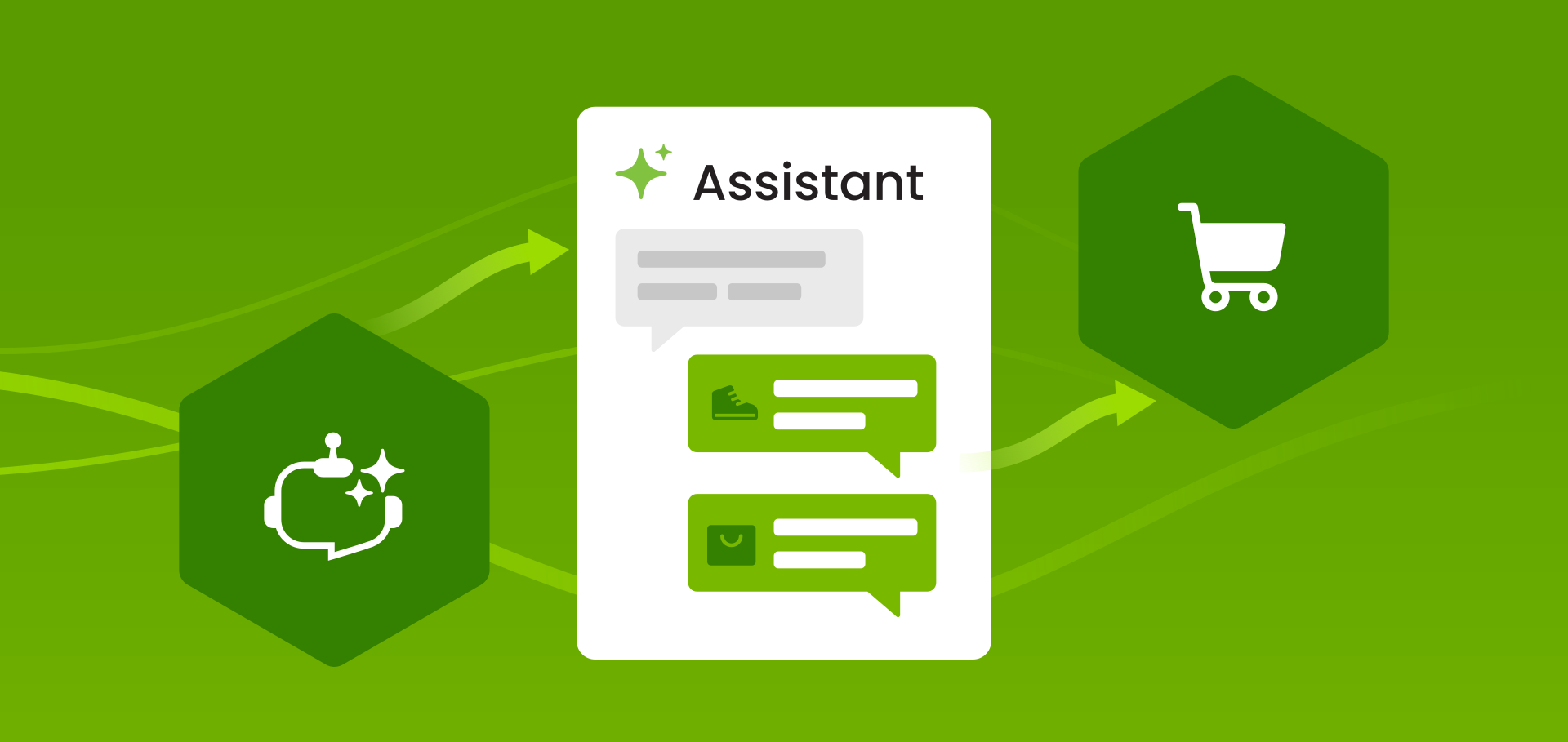
Agentic analytics sits at the intersection of AI agents and data analysis. The "agentic" part refers to AI systems that perceive, reason, and deliver insights rather than simply waiting to be queried — systems that can break a complex analytical request into component tasks, execute them across data sources, and synthesize a structured answer. The "analytics" part means that capacity is directed at understanding data and driving business decisions.
The result is an analysis workflow that operates differently from conventional business intelligence. An agentic analytics platform can surface insights proactively — the most important patterns appearing on a homepage or in an automated report without anyone asking — or respond to a natural language question far more efficiently than a manual workflow would allow. According to Gartner's Market Guide for Agentic Analytics (G00841394, February 2026), agentic analytics is "software used for the process of data analysis that applies AI agents across the data-to-insight workflow, orchestrating tasks semiautonomously or autonomously toward stated goals that support, augment or automate insights." Notably, the definition centers on automating insights — not on agents taking autonomous action in the world.
One clarification matters for practitioners: agentic analytics (agents doing the analysis) is distinct from agent analytics (analyzing AI agents). Both are emerging capabilities, and both are part of Conviva's platform — but they solve different problems. Agentic analytics reduces the analyst bottleneck. Agent analytics gives teams visibility into whether their consumer-facing AI agents are performing.
Why agentic analytics matters
- The analyst bottleneck is real: In most organizations, the time between an operational question arising and an analyst delivering an answer is measured in hours or days. Agentic analytics compresses that to seconds — and removes the queue entirely for routine analytical tasks.
- Data complexity has outpaced human capacity: Modern digital products generate billions of events per day across apps, websites, streaming platforms, and AI agents. No analyst team can monitor that volume continuously. Agentic systems can.
- Real-time decisions require real-time intelligence: A streaming quality issue during a penalty kick, a checkout friction spike during peak traffic, a customer service agent producing off-brand responses — these moments require detection and response in seconds, not after the morning standup.
- Adoption is accelerating rapidly: According to Gartner's 2025 Generative and Agentic AI in Enterprise Applications Survey, 41% of organizations have deployed or are actively deploying AI agents, and 79% of IT leaders believe the productivity impact will be significant. Analytics and BI is the number-one domain expected to see the most impact from AI agents.
- The analytics market is converging: Established BI vendors, data platform providers, and purpose-built analytics players are all extending into agentic analytics — making vendor selection and architectural choices time-sensitive decisions.
Core components
Natural language interface
- Accepts plain-language questions in English or any other language from any team member — no query syntax, no SQL, no dashboard expertise required.
- Converts prompts into structured, multi-level analytical queries across one or more data sources.
- Supports multi-turn conversations, allowing users to progressively refine or deepen an investigation within a single session.
Agent workflow orchestration
- Breaks complex analytical requests into component tasks and coordinates the analysis across data sources to deliver a synthesized answer.
- Adapts the analytical approach dynamically as new data or intermediate findings emerge.
Context and semantic layer
- Grounds agent reasoning in organizational knowledge: business rules, metric definitions, past analyses, domain ontologies, and context graphs.
- Ensures that agent outputs reflect business meaning — not just statistical patterns — reducing hallucination and improving interpretability.
- Gartner predicts that by 2028, 60% of agentic analytics projects relying solely on Model Context Protocol (MCP) without a consistent semantic layer will fail (Market Guide for Agentic Analytics, G00841394, February 2026).
Automated insight generation
- Can proactively identify anomalies, trends, and behavioral patterns and surface them without waiting for a user to ask.
- Surfaces findings ranked by business impact, with confidence caveats and source traceability.
- Can generate shareable reports, dashboards, and scheduled digests.
Governance and human oversight
- Supports escalation paths that define when human review or intervention is appropriate.
- Logs the full analytical process for auditability — so teams can trace exactly how a recommendation was reached.
How agentic analytics works in practice
During the opening week of the 2026 FIFA World Cup — the largest in tournament history, spanning 48 teams and 104 matches across 16 venues — Conviva's agentic analytics platform supported more than 20 streaming providers recording 26.37 million peak concurrent plays. The operational challenge was acute: a quality degradation during a goal or penalty kick generates immediate social backlash and subscriber churn.
Three patterns from that deployment show what agentic analytics looks like in production:
Week-over-week adoption of Nexa agentic analytics was up more than 20% across the tournament's opening week, as operations teams integrated AI-assisted analysis into daily workflows they had not previously used it for. The pattern is consistent with what Gartner describes as a shift from exploratory use toward early-scale deployment anchored to specific, high-value, repeatable analytical tasks.
Key benefits
- Speed to insight: Agentic analytics compresses the time from question to answer from hours or days to seconds — enabling decisions at the pace of the business, not the pace of the analyst queue.
- Continuous monitoring at scale: AI agents operate 24/7 across billions of events, surfacing anomalies and opportunities that no human team could detect through manual review.
- Democratized analysis: Any team member — operations, marketing, product, customer support — can ask analytical questions in natural language and receive structured, trustworthy answers without needing data science expertise.
- Outcome-linked intelligence: The best agentic analytics platforms connect behavioral signals to business outcomes — not just what happened, but what it means for conversion, retention, revenue, and customer experience.
- Operational efficiency: Automating routine reporting and monitoring frees human analysts for higher-value work: strategic investigation, model design, governance, and judgment-intensive decisions that agents cannot yet make reliably.
- Compounding improvement: With a human-on-the-loop model, agents improve over time through structured feedback cycles — reducing error rates and increasing autonomous resolution rates as organizational context accumulates.
Use cases by industry
- Streaming and media: Real-time quality monitoring during live events — detecting playback failures, buffering spikes, and CDN issues across millions of concurrent sessions before viewers feel them, with Nexa surfacing root causes and ranked recommendations within seconds.
- E-commerce: Continuous analysis of purchase flow behavior across apps and websites — proactively flagging checkout friction, identifying high-intent behavioral patterns that predict conversion, and automating the operational reporting that previously required dedicated analyst time.
- Travel and hospitality: Autonomous monitoring of booking flows and search-to-purchase sequences — surfacing the behavioral cohorts most likely to upgrade, abandon, or churn, and delivering that intelligence to revenue teams before the session ends.
- Financial services: Proactive detection of interaction patterns that signal user frustration or intent to switch — identifying them across the full cross-channel journey (app, web, and AI agent) rather than within any single touchpoint.
- AI agent deployments: Continuous analysis of on-site and in-app AI agent conversations — identifying which conversational patterns, response types, and behavioral sequences correlate with resolution, purchase, or abandonment at the session level.
Agentic analytics vs. traditional analytics
| Dimension | Agentic Analytics | Traditional Analytics |
|---|---|---|
| Initiation | Proactive — agents may monitor and surface findings continuously as well as respond to queries | Reactive — human must define the question and initiate the query |
| Interface | Natural language conversation with contextual follow-up | Dashboard configuration, drag-and-drop reports, SQL queries |
| Insight timing | Real-time — findings can surface before decisions are made | Often delayed — reports typically require human initiation and manual interpretation after the fact |
| Scale | Full-census continuous monitoring across billions of events | Many traditional product analytics and business intelligence platforms sample or batch-process data, forcing analysts to make decisions on subsets of information |
| Analyst role | Strategic oversight, governance, and high-judgment decisions | Primary query builder, report generator, and insight communicator |
| Outcome linkage | Behavioral patterns directly connected to revenue, retention, conversion | Metrics tracked; correlation to outcomes requires additional manual analysis |
| Adaptation | Agents improve through feedback loops and accumulated organizational context | Dashboards are static; updating requires manual reconfiguration |
The transition may not be binary. Many organizations are moving from traditional product analytics or BI to agentic analytics progressively — starting with natural language query capabilities layered onto existing data (for example, querying data from their database within Claude or another AI assistant), then adding proactive monitoring, then expanding to autonomous multi-step investigation as governance maturity increases. Gartner describes this as a progression from "human-in-the-loop" (agents assist, humans verify every step) to "human-on-the-loop" (humans serve as guardians monitoring agent performance, while agents execute autonomously) — a framework outlined in The End of Human-First Analytics Leads to an Agentic Future (G00842691, January 2026). Advanced organizations are already deploying full agentic analytics tools like Nexa today.
Challenges and considerations
- Semantic layer maturity: Agents are only as reliable as the context they operate on. Without well-governed ontologies, metric definitions, and context graphs, agents can generate plausible-sounding but incorrect or misaligned outputs.
- Data quality and completeness: Agentic analytics on sampled or poorly instrumented data produces sampled or poorly grounded insights. Full-census telemetry — capturing every session, every interaction, every agent conversation — is the only foundation that supports reliable pattern detection at scale.
- Governance and escalation design: As agents gain autonomy, defining clear escalation paths (when should a human review before a recommendation is acted upon?) and confidence thresholds becomes critical. Most early-scale deployments underinvest here.
Related technologies and concepts
Getting started with agentic analytics
1. Establish full-census data collection before deploying agents
Agents can only surface what the underlying data captures. Sampled telemetry produces sampled insights — which means the patterns that matter most (the rare failure modes, the high-value micro-cohorts) are precisely the ones most likely to be missing. Full-census, client-side instrumentation across every touchpoint is the precondition for reliable agentic analytics.
2. Build or validate your semantic layer
Before asking an agent to reason about your business data, ensure your metric definitions, KPI logic, and domain ontologies are documented, consistent, and accessible to the agent. An agent operating on ambiguous or inconsistent semantic foundations will produce ambiguous or inconsistent outputs.
3. Start human-in-the-loop; move toward human-on-the-loop deliberately
Begin with agents that assist analysts — surfacing recommendations for human review before any action is taken. Track task success rates and error decay rates. As agent reliability improves in bounded use cases, gradually expand autonomous execution while maintaining clear escalation paths for edge cases and high-stakes decisions.
4. Instrument governance from the start, not after scale
Define who owns each category of agent output (performance patterns to engineering, conversion patterns to growth, agent performance to product), set confidence thresholds for autonomous action, and implement cost-per-insight monitoring before expanding beyond pilot deployments.
5. Measure outcomes, not just activity
The right success metrics for agentic analytics are time to insight (elapsed time from analytical need to validated, actionable finding), autonomous resolution rate (percentage of analytical workflows completed without human intervention), and insight value (whether recommendations led to measurable business improvement). Track these against a pre-deployment baseline to demonstrate and sustain organizational investment.
Key Takeaways
- Agentic analytics applies AI agents to the data analysis workflow — autonomously querying, analyzing, and surfacing insights rather than waiting for a human analyst to initiate the process.
- It is distinct from agent analytics: agentic analytics uses agents to do the analysis; agent analytics analyzes AI agents to measure their performance.
- Core capabilities include natural language querying, automated insight generation, agent workflow orchestration, semantic context grounding, and governance guardrails.
- Successful deployment requires full-census data, a mature semantic layer, defined escalation paths, and success metrics anchored to business outcomes — not just analytical activity.
- The market is in early-scale adoption: organizations are moving from pilots to production deployment, with differentiation shifting toward semantic maturity, governance design, and outcome-linked intelligence.
See Agentic Analytics in Action with Conviva
Conviva's Nexa is an agentic analytics solution built on full-census, real-time telemetry across apps, websites, streaming platforms, and AI agent interactions. Teams ask questions in natural language and receive ranked, outcome-linked insights drawn from tens of millions of concurrent sessions — without dashboard configuration, query expertise, or analyst queue time. Discover how leading retailers, airlines, and media companies are deploying Nexa to replace reactive reporting with proactive, always-on analytical intelligence.
Learn more: Conviva Blog · Follow us on LinkedIn · Browse the full Glossary