



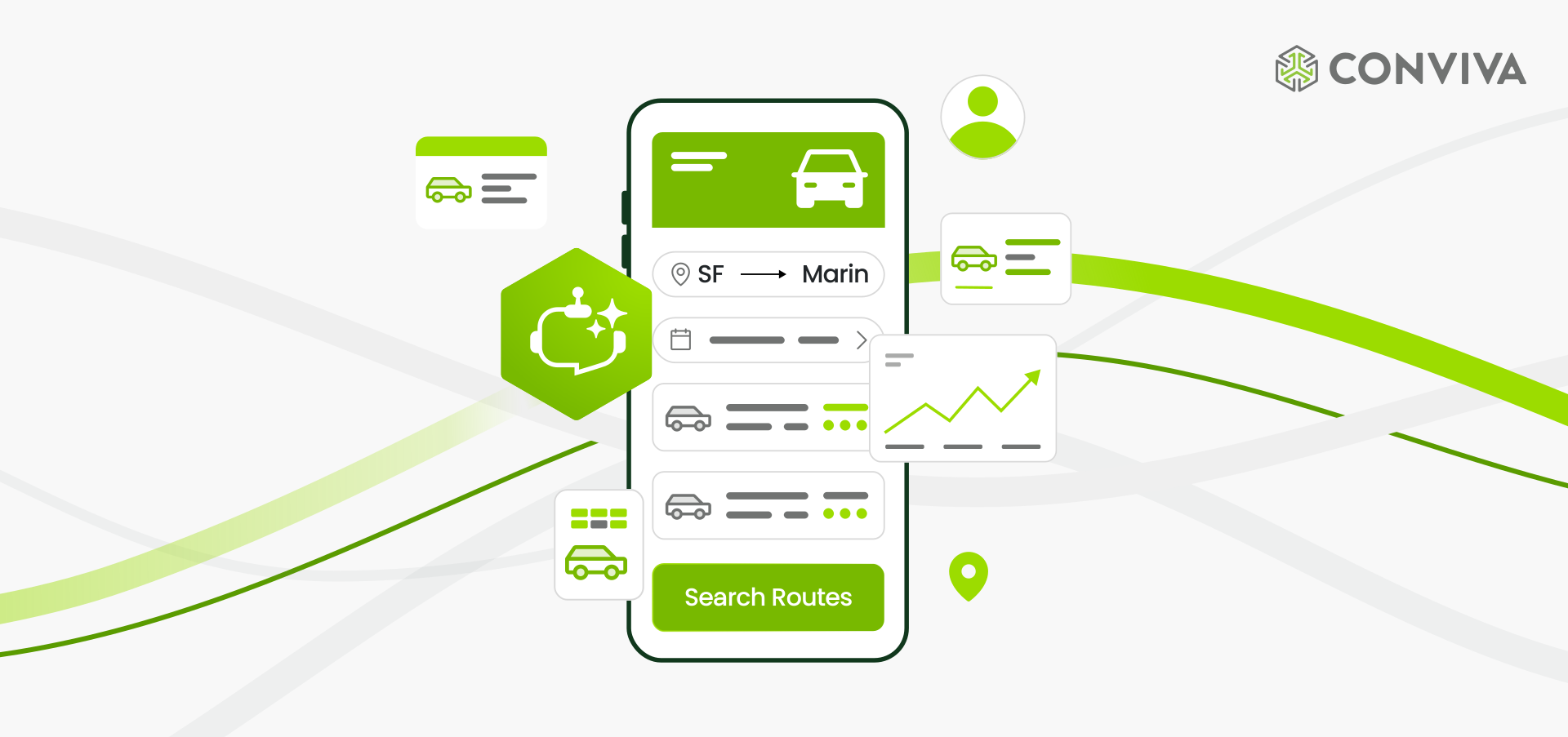
Imagine you’re trying to give someone directions from San Francisco to Marin. You could tell them to take South Van Ness to 101, cross the Golden Gate bridge, take the third exit, and turn right. A fixed path, defined in advance, built on the assumption that nothing changes along the way.
But everything changes along the way. There’s construction on 101. They need gas. They take a wrong turn. The verbal directions don’t know any of that, and they can’t adjust to the driver’s actual experience.
Now think about Google Maps. It knows where you are in real time. It knows what every possible route looks like right now. If there’s an accident on 101, it reroutes you before you hit it. If you take a wrong turn, it recalculates instantly. It doesn’t just tell you where to go — it tells you when you’ll arrive, accounting for everything that’s happening right now.
That’s the difference between traditional product analytics and pattern analytics. Most organizations are navigating with verbal directions. Pattern analytics is Google Maps.
What Traditional Product Analytics Actually Measures
Your current analytics platform — whether it’s Adobe, Amplitude, or Mixpanel — captures events. A page view. A click. An add-to-cart. A session start and a session end. These are individual data points, each recorded in isolation.
From those events, your team builds reports: funnel drop-off rates, average session length, pages per visit, overall conversion rate. These metrics are useful as far as they go. But they rest on a critical assumption: that the average behavior of all users is a meaningful guide to what any individual user needs.
That assumption is wrong — and acting on it at scale creates friction for customers who veer from its neatly defined path.
Here’s a simple example that illustrates why.
The Same Metric. Opposite Meanings.
A road warrior who flies for work every week knows her airline’s app like the back of her hand. She logs in, runs a quick search, confirms her preferred flight, and books in under two minutes. For her, a short session is a success signal. If she’s spending ten minutes on the app — toggling between dates, running repeated searches, comparing options, switching to the website and back — something is wrong. A seat availability issue. An interface problem. Friction where there should be a single confirmation tap.
Now consider someone booking a trip to Sri Lanka once a year to visit family. It’s a 24-hour journey with a layover. He starts looking four months out. He visits the app across multiple sessions, comparing dates and routing options, cross-referencing school calendars and family schedules. Long sessions, many visits, extensive back-and-forth — that’s not a problem. That’s the expected pattern of a high-intent customer making a complex decision.
Both customers produced the same aggregate session metric. Traditional analytics collapses them into the same cohort and serves them the same optimization. Pattern analytics distinguishes them — because the sequence of what happened, in what order, with what time between each step, tells a completely different story.
This is the insight that changes how digital experiences should be built and measured. The same metric can signal success for one customer and failure for another. Pattern analytics is how you tell them apart.
What Pattern Analytics Is
Pattern analytics is the capability to identify stateful, sequential, time-aware behavioral fingerprints across your full user population — automatically, at scale, and in real time.
A few things make that definition worth unpacking.
Stateful and sequential. Patterns aren’t individual events — they’re the full arc of what happened, in what order, with what time between each step. That temporal dimension, what Conviva calls time state, is what allows a pattern to emerge from raw behavior. Two customers can both add to cart, leave, and return 48 hours later. The events are identical. The time gap is identical. But one had a smooth experience and just needed time to decide. The other hit a broken filter, couldn’t find their size, and left frustrated. Traditional analytics puts them in the same “cart abandonment” cohort. Pattern analytics reads the session arc leading to that pause and can understand the difference.
Automatic and exploratory. You don’t pre-define the patterns you’re looking for. They surface from the data. This is the structural difference from building a funnel report, where you define the path in advance and measure whether users followed it. Pattern analytics finds the paths users are actually taking — including the ones you didn’t anticipate.
Full census. Patterns require volume to be statistically meaningful. Sampling creates blind spots: rare but high-value patterns disappear, narrow cohorts lose statistical confidence, and emerging behaviors get filtered out before they’re detectable. Conviva captures every session — no sampling, no synthetic proxies, no session replay approximations. That means you can identify patterns within cohorts as specific as “premium loyalty members who only shop during promotional windows” or “frequent flyers on a specific route” without losing the signal.
Real-time. Traditional analytics tells you what happened last week. Pattern analytics shows you what’s happening right now — and can flag when a session is trending toward abandonment, when a technical issue is creating friction in a specific geography, or when a new behavioral pattern is emerging before you’ve consciously noticed it.
What Patterns Look Like in Practice
Patterns aren’t abstract. The clearest way to understand what they surface — and why they’re different from what event-based analytics produces — is to see them in context.
Consider a woman shopping on Nike’s site. On Tuesday afternoon, at her son’s baseball practice, she notices he needs a new bat. From her phone, she finds the same one he’s used for years, adds it to cart, and checks out in under five minutes. Urgent need, mobile context, no browse — just direct search, add, pay. That’s a pattern that repeats across thousands of Nike shoppers in high-pressure, kids’ gear situations.
The next day, same woman, different device, different intent. She’s thinking about training for a marathon. She browses running shoes, interacts with Nike’s product recommendation agent, and leaves without purchasing. Two days later she returns on her phone, then later on her home laptop, where she asks ChatGPT for a second opinion before returning to Nike’s site and checking out — with the shoes and upsells for running apparel. Different pattern entirely: considered lifestyle purchase, multi-device, AI-assisted, extended decision horizon, high upsell affinity.
Same Nike Member account. Two completely different patterns — different context, different intent, different intervention required. If Nike’s system only sees “shopper with kids’ gear history,” it misfires on the marathon journey. If it only sees “marathon shopper,” it adds friction to the urgent transaction she needs to complete in five minutes from a bleacher.
Pattern analytics detects which pattern is in play in real time — and serves the right experience for each.
Why “Event-Based” Is the Wrong Foundation
The distinction between event-based and stateful analytics is worth being precise about, because most PMs and data analysts have spent decades thinking they’re already leveraging rich behavioral data. They may be, but it’s almost certainly event-based, not stateful.
Event-based analytics answers: what did this user do? Stateful, sequential analytics answers: what did this user do, in what order, with what time between each step — and what does that sequence reveal about who they are and what they need?
The second question is the one that drives actionable personalization, meaningful anomaly detection, and the kind of AI agent intelligence that doesn’t embarrass the brand. The first question, answered in aggregate, is how most organizations are currently operating.
Think about two customers who both add to cart and leave items in an open tab for 48 hours. Event-based analytics sends them both a cart reminder email. For the first customer — who had a smooth experience and just needed time — the reminder works. For the second customer — who hit a broken checkout flow and left frustrated — the reminder doesn’t fix the friction. It signals that you missed what happened and ruins any chance you had of reengaging them.
Stateful pattern data is the difference between knowing someone paused and knowing what the pause means.
The Forward-Looking Case: Patterns and AI Agents
The present-day applications are substantial on their own. But there’s a reason patterns matter even more as AI agents move into the customer experience: an agent is only as intelligent as the behavioral context it can draw on.
An AI booking agent for an airline that doesn’t know the business traveler’s pattern will recommend the wrong flight time, ask if she’s open to surrounding airports, or miss a status upgrade. An agent at a retailer without context will try to upsell at the wrong moment — pushing discovery content to the customer who wants the fastest path to checkout.
The consumer context graph that pattern analytics builds — the accumulated, persistent record of what a customer consistently does, session over session, across time — is what turns an AI agent into something that can actually improve the customer experience.
Are You Using Verbal Directions or Google Maps?
Most brands today are navigating their digital experiences with verbal directions. They know the route they built. They can tell you how many people followed it. What they can’t tell you is what’s happening right now, for this customer, in this session — or what it means.
That’s what pattern analytics changes. Not just better reporting on what happened, but a real-time operating system that understands what’s happening and why — for each type of customer, every time they show up.
Want to learn more? See how to put patterns to work for you.