
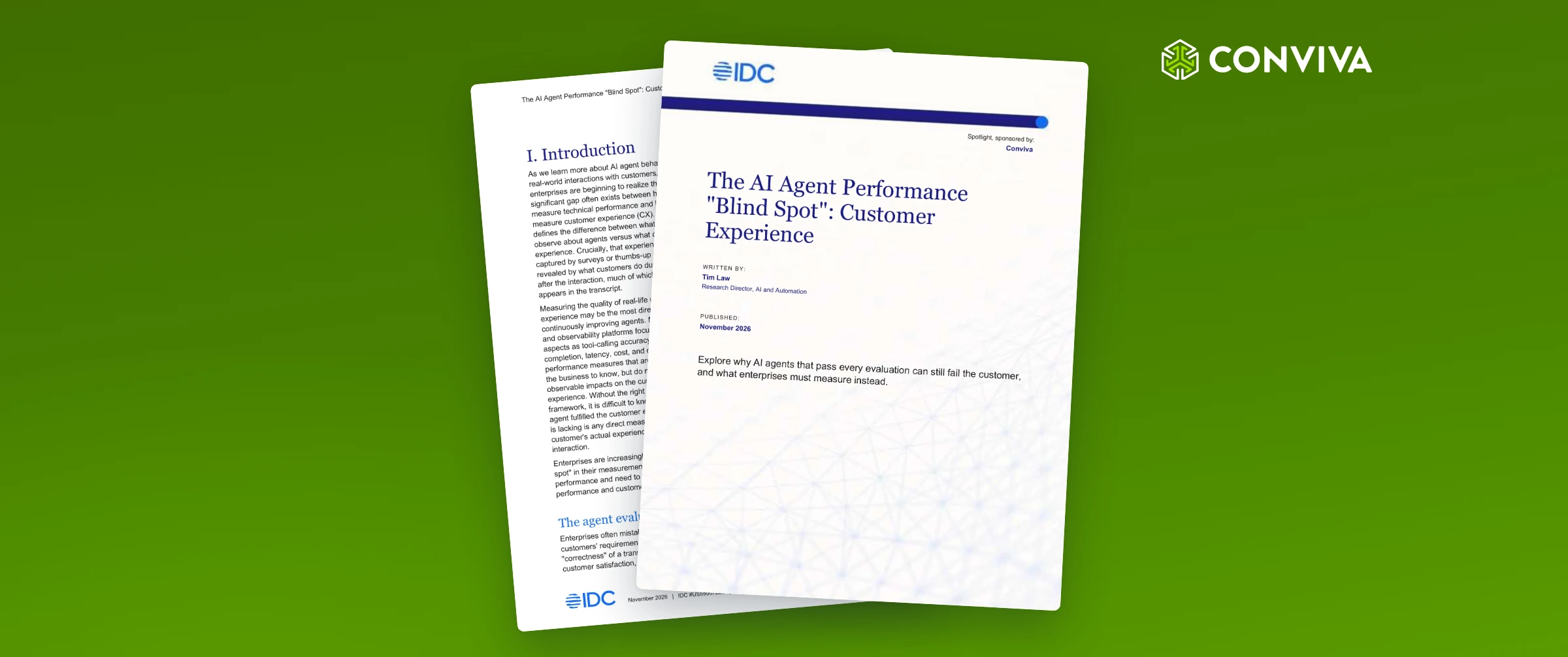
AI agents can pass every evaluation and still fail the customer. A new IDC Spotlight, The AI Agent Performance "Blind Spot": Customer Experience, examines why. Most teams measure AI agents with metrics like accuracy, latency, task completion, and cost. As the IDC Spotlight puts it, "What is lacking is any direct measure of the customer's actual experience during the interaction." Closing that gap means measuring agent experience from what customers do during and after the interaction, not from surveys or thumbs-up ratings.
What is the AI agent performance blind spot?
The blind spot is the gap between what teams can observe about an AI agent and what customers actually experience. Evaluation scores show whether a response was correct. They don't show whether the customer got what they came for.
According to the IDC Spotlight, "Without a complete picture, when it comes to customer experience, the current state of agent performance evaluations is at best inferred, and at worst a guess."
The usual proxies fall short. Few customers leave a rating, and a "resolved" status only means the conversation ended.
Key findings from the IDC Spotlight
- Agent budgets are overrunning. The IDC Spotlight reports: "In fact, two-thirds (67%) of enterprises ran over their agent spend budget in the past 12 months (source: IDC's Future Enterprise Resiliency and Spending Survey [FERS Survey] Wave 4, July 2026)."
- Customer experience is missing from the priorities. According to the IDC Spotlight, the key goals for deploying agents in customer service organizations are to augment the human workforce with AI agents (57%), move beyond manual tasks (56%), and improve competitive advantage (54%). Efficiency leads the list. Customer experience doesn't make it.
- Autonomy has stalled where CX matters most. The IDC Spotlight finds that "The lack of complete understanding of impact on customer experience inhibits full autonomy."
Put together, the picture is clear: teams are spending more on agents than they planned, they're optimizing for efficiency, and they can't give agents more autonomy because they can't see how customers are being served.
Six metrics that measure agent experience
The IDC Spotlight identifies six metrics:
- Turns to understanding intent: How many exchanges it takes before it's confirmed with the user that the agent understands what they came for
- Clarification rate: How often the user must stop and restate what they meant
- Correction rate: How often the user corrects the agent or redirects it mid-task
- Scope-narrowing rate: How often the user shrinks the request to something the agent can handle
- Downstream rework rate: How often the user redoes the agent's work afterward, often somewhere else
- Fallback rate: How often the interaction ends in a human handoff, a canned response, or an abandoned task
None of these signals come from a survey or a thumbs-up. They come from what customers actually do, which is why they show where an agent is creating friction even when every response looks correct.
Why agent experience is also a cost problem
Poor agent experience and wasted token spend come from the same source. According to the IDC Spotlight, "Experience inefficiency and token waste are the same problem viewed two ways." Each turn a customer didn't need adds to the bill and takes them further from what they came for.
A spike in token spend can look like an agent working harder when it's actually failing. The IDC Spotlight concludes that "High token spend with poor customer experience is pure waste" and that "The fastest way to cut agent spend is to eliminate the turns customers never needed."
That's also where the opportunity is. When teams can see which turns customers didn't need, they can cut spend and improve the experience at the same time.
What the IDC Spotlight recommends
The IDC Spotlight outlines four steps for closing the blind spot:
- "Measure experience, not just responses." A response can be accurate and still be a bad customer experience.
- "Measure the full population in production, not samples." Sampling can make the average interaction look fine while missing the failures that cost loyalty and revenue.
- "Compare segments to find where the agent fails." Agent failures are rarely uniform, and averages wash them out.
- "Tie experience metrics to token spend." Only then can teams tell an agent doing more valuable work from an agent that's failing.
How Conviva measures agent experience
For 20 years, Conviva has measured quality of experience for the moments millions of people share, from live sports streams to the agents customers now talk to every day.
Agent Experience Insights measures the human side of every agent conversation, including behavior on the surrounding website or app that never appears in the transcript, such as manual searches mid-conversation, purchases made outside the chat, downstream rework, and return visits about the same issue.
Conviva's approach is built on the EPIC framework:
- Experience: stateful experience metrics, inside and outside the conversation
- Population: full-census client-side telemetry across every session, with no sampling
- In production: real-time automated insights on live traffic
- Contrastive: pattern detection that compares overperforming and underperforming segments to show where experience breaks down and why
IDC Spotlight, The AI Agent Performance "Blind Spot": Customer Experience, November 2026, IDC #US55007226.
FAQ
How do you measure the customer experience of an AI agent?
Measure what customers do, not just what the agent says. Start with the six behavioral metrics the IDC Spotlight identifies, listed above. Track them across every session in production, then compare customer segments to find where the experience breaks down. Conviva's Agent Experience Insights computes these signals inside and outside the conversation.
Why do AI agents pass evaluations but still fail customers?
Evaluations measure whether a response was correct, not whether the customer's problem was solved. Most evaluations, including LLM-as-judge, only see the transcript. A polite, accurate answer can still leave a customer repeating themselves or giving up, and none of that shows up in an evaluation score.
What is agent experience?
The IDC Spotlight defines it this way: "Agent experience is the customer's perceived outcome and efficiency of an agent interaction: whether they got what they came for, how efficiently, and whether they came away satisfied. It is derived from behavioral signals rather than self-reported feedback." Agent experience is the human side of AI agent analytics, and it's what Conviva measures.
How do AI agents waste tokens?
AI agents waste tokens on turns the customer never needed: repeated clarifications, retries, corrections, and time spent gathering context. When the conversation still ends with the customer giving up, all of that spend produced nothing. Tying token spend to experience metrics shows which spending is waste.
What is the difference between AI agent evaluation and agent experience measurement?
AI agent evaluations test accuracy, task completion, latency, and cost, usually before an agent ships or on sampled traffic. Agent experience measurement looks at how real customers experienced every interaction in production, using behavior during and after the conversation. Teams need both: an inside-out view of performance and an outside-in view of the customer.